
Fixed Income Letter | Issue 08 – November 2026
Analyst: Kauê Brito, Levy Freitas & Raquecia Torres

Summary
The November 2026 Fixed Income Letter covers a month in which the relief in interest rates was undone. After the second round of the presidential election on October 25, long-term rates rose sharply, and the yield on the Tesouro Prefixado 2029 went from 12.40% to 14.72%. October inflation slowed to 0.14%, but the 12-month figure rose to 4.63%, above the 4.50% ceiling of the inflation target. On November 4, the Central Bank paused its rate cuts and held the Selic at 13.75% a year. The Fiscal Risk Indicator fell to 2.8 out of 10, its first drop in three issues, and the country remains in the defense zone. In credit, the default rate in Brazil held at 5.0%, the highest in the series, while in Ceará it rose to 5.35%. With long-term rates more volatile and the fiscal adjustment still being voted on in Congress, bonds linked to the Selic remain the most efficient way to protect wealth.
1. What the Fixed Income Letter is
The Fixed Income Letter is the monthly publication of Ceará Finance's Fixed Income team. It brings together a reading of the economy, an assessment of public finance risk, the behavior of credit, Brazilian Treasury bond yields and a risk and return comparison across fixed income investments. The goal is to explain what moves interest rates and how this affects investment decisions, in language that is accessible to readers who do not follow the market every day. This is the eighth issue of the series and the second with a chapter dedicated to the credit market.
2. Inflation slows, but stays above the ceiling
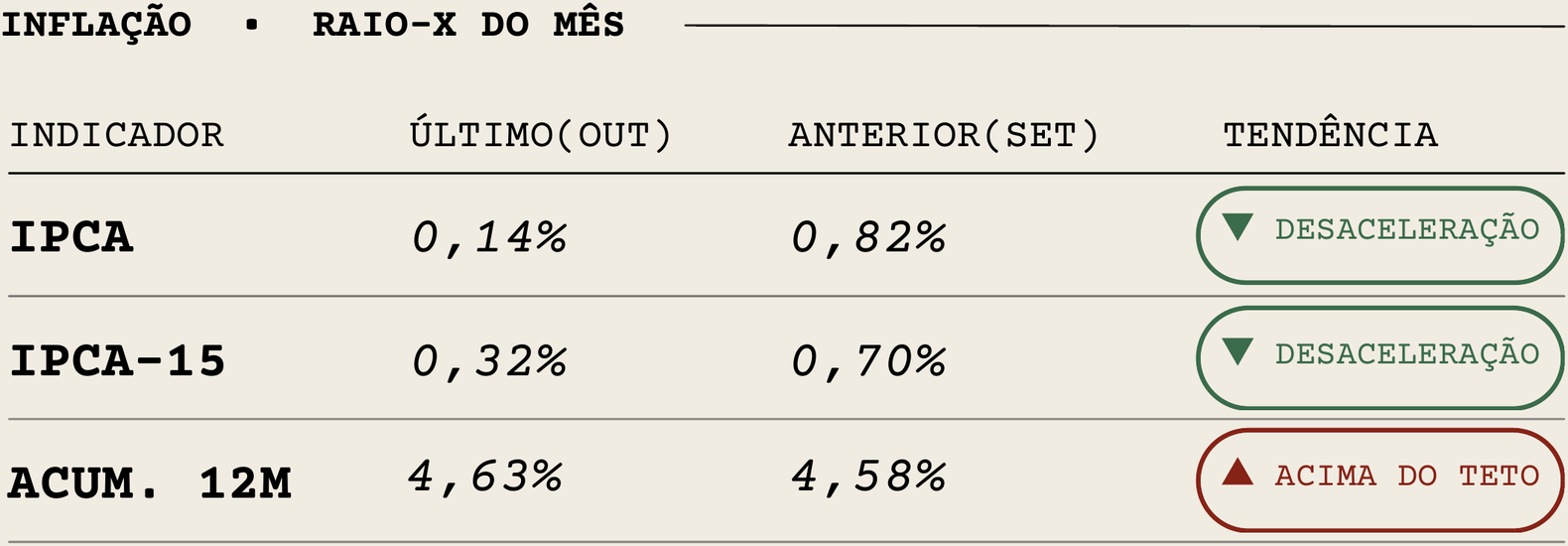
The IPCA, Brazil's official inflation index, rose 0.14% in October, after 0.82% in September, and came in below the 0.26% expected by the market. Transportation and Housing fell, but food at home rose 1.31%, which points to a one-off relief rather than a trend. The 12-month figure went from 4.58% to 4.63% and remains above the 4.50% ceiling of the target. The IPCA-15, a preview of inflation, also slowed, from 0.70% to 0.32%.
3. Economic activity and the external scenario
The market now expects 2026 GDP growth of 1.75%. Employment shows mixed signals. The September Caged, Brazil's formal employment registry, recorded 121,300 formal jobs, the weakest result for the month since 2020, while unemployment fell to 5.2% in the quarter, the lowest for the period since 2012. Abroad, the Fed, the United States central bank, kept US rates in the 3.75% to 4.00% range on October 28, with two votes in favor of a hike, and left the December decision open. With high rates around the world and a stronger dollar, Brazil has to pay more on long-term bonds to attract foreign investors, which makes it harder for local rates to fall.
4. Focus and Copom, a pause in rate cuts
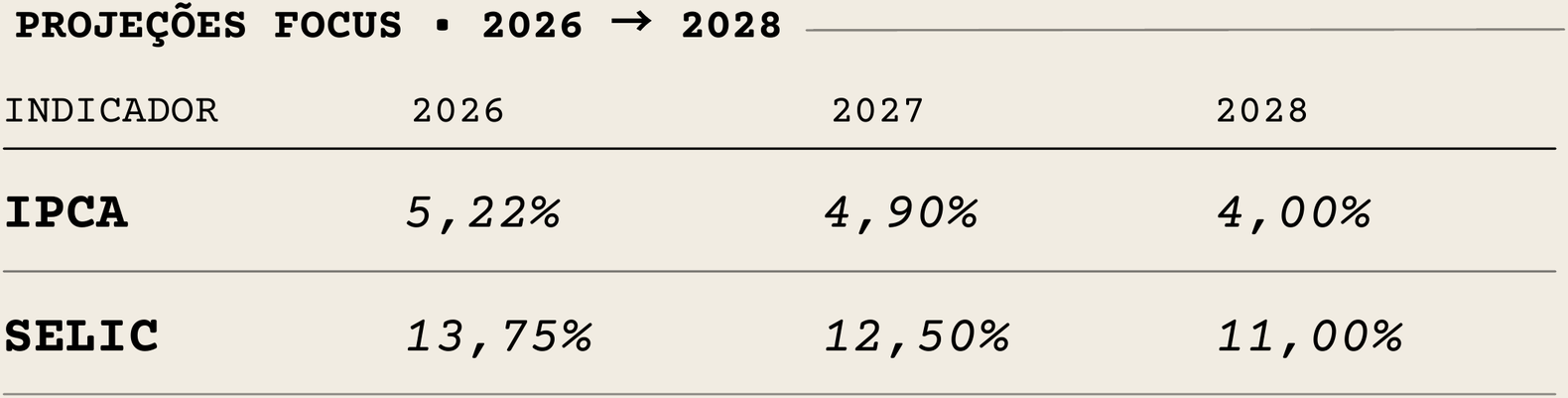
The Focus Bulletin, the Central Bank's weekly survey of market forecasts, kept the inflation expectation for 2026 at 5.22%, the same as a month earlier. The change came in the following year. The forecast for 2027 jumped from 4.30% to 4.90%, and the one for 2028 stands at 4.00%, still far from the target. For the Selic, the market now expects 13.75% at the end of 2026, against 13.25% a month earlier, 12.50% in 2027 and 11.00% in 2028. As a result, the room for further cuts this year is gone.
On November 4, the Copom, the Central Bank's Monetary Policy Committee, held the Selic at 13.75% a year in a unanimous decision and ended a cycle of five cuts that began in March, when the rate stood at 15.00%. In the minutes released on November 10, the Committee signaled that rates will stay high for longer and raised its inflation forecast for the horizon that guides its decisions from 3.2% to 3.5%. The yield curve had already reacted to the second round result. The yield on the Tesouro Prefixado 2029 rose 2.32 percentage points, from 12.40% to 14.72%, and the yield on the Tesouro Prefixado with semiannual interest 2037 rose 2.69 points, to 15.19%, which lowered the price of these bonds. The next Copom meeting will be on December 8 and 9.
5. Fiscal scenario, the IRF falls again
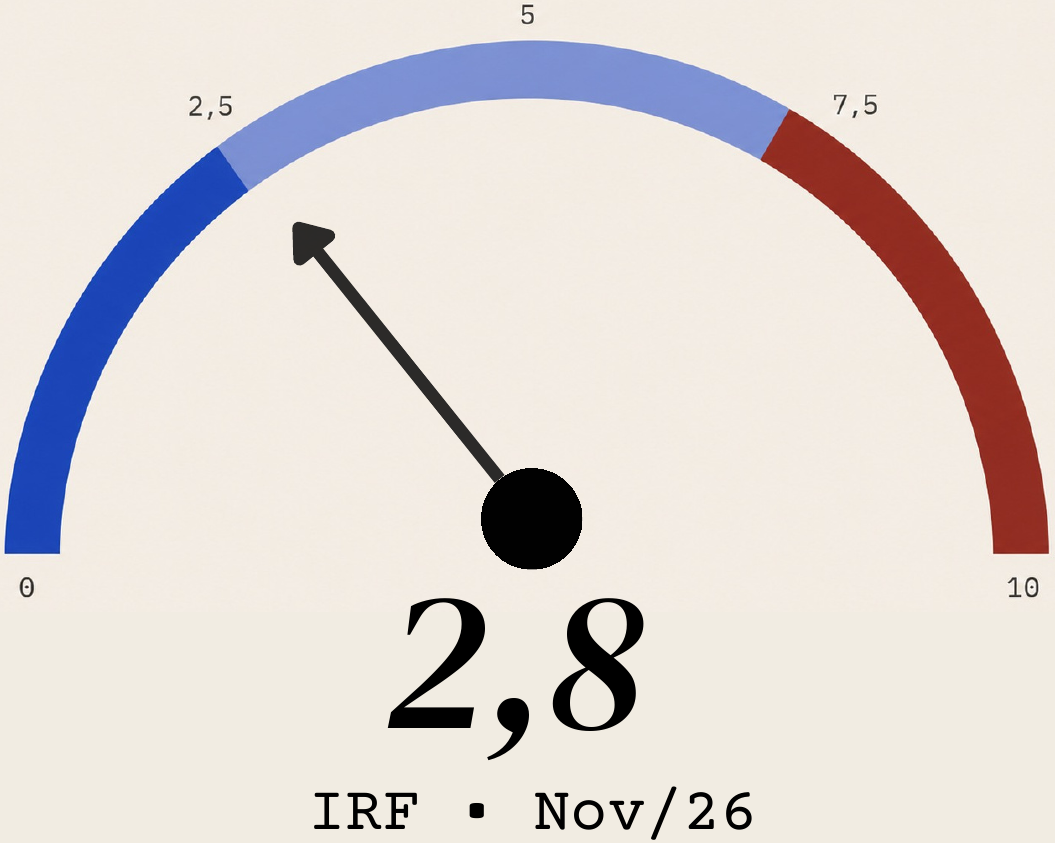
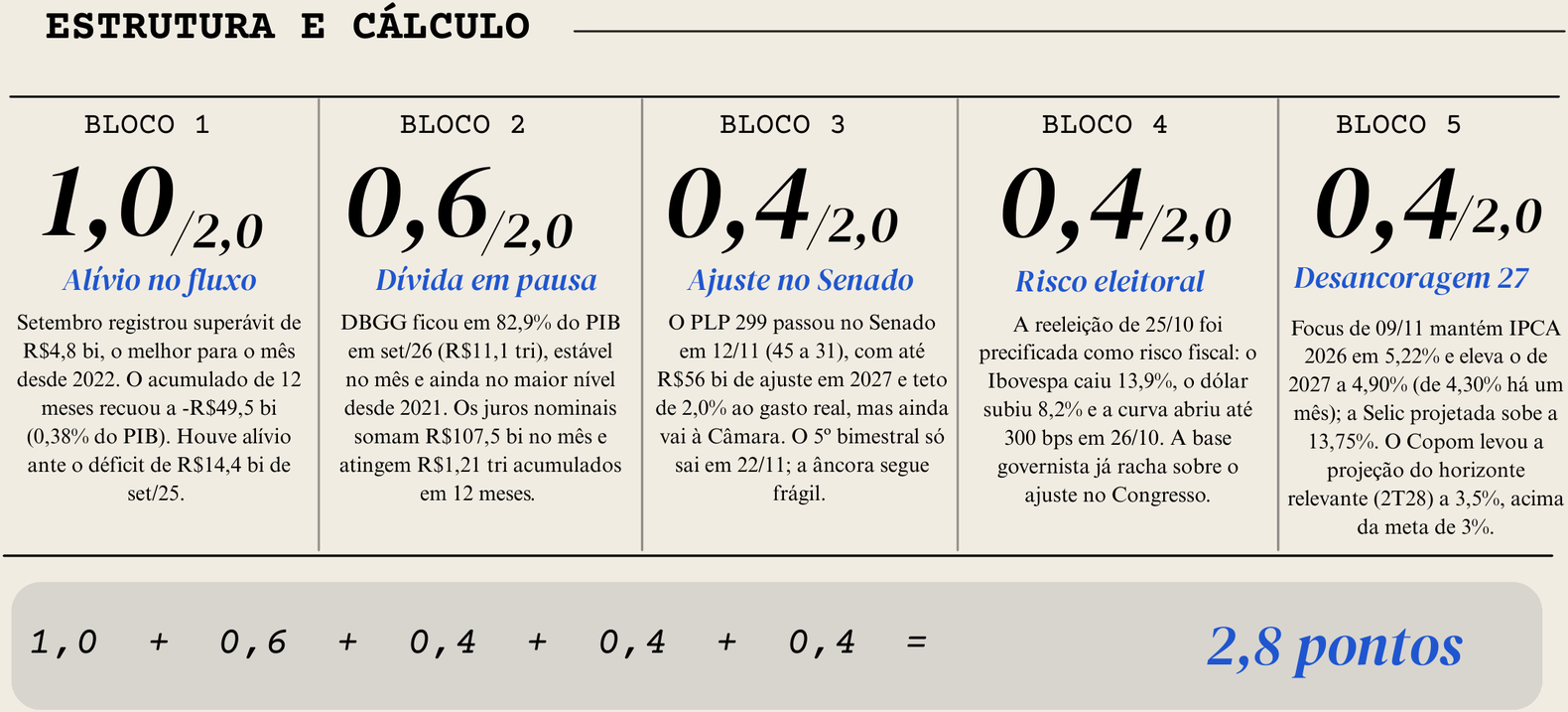
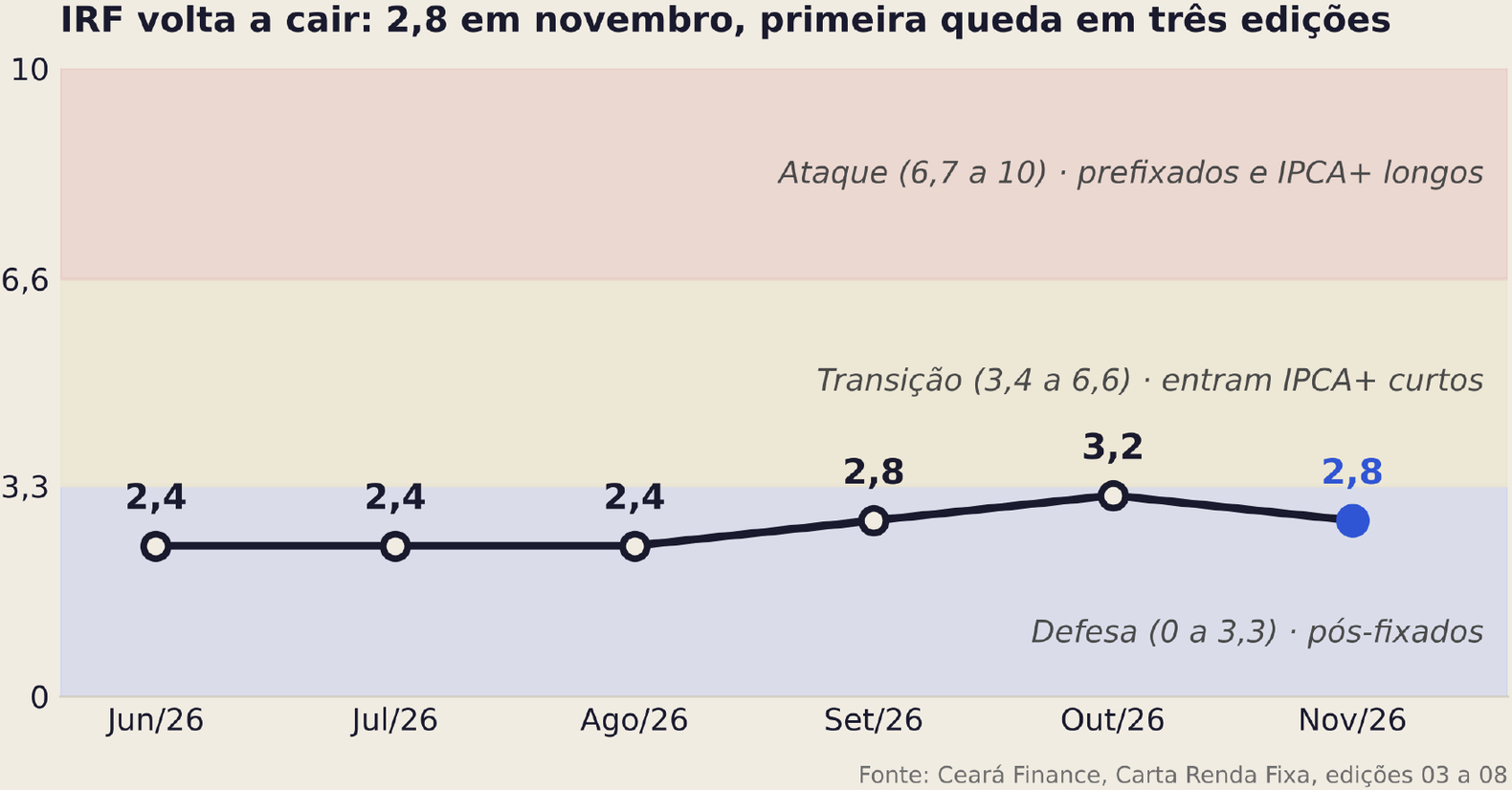
The Fiscal Risk Indicator (IRF) is a tool developed by the team that turns public finance data into a score from 0 to 10. The goal is to anticipate interest rate moves before the market prices them in and to signal when it is time to protect wealth or to lock in high rates. In November, the score fell from 3.2 to 2.8, the first drop in three issues, and the country remains in the defense zone.
The score is the sum of five blocks, each worth up to 2 points. The government posted a primary surplus of R$ 4.8 billion in September, the best result for the month since 2022, against a deficit of R$ 14.4 billion a year earlier (1.0 point). Gross public debt stayed at 82.9% of GDP, still the highest level since 2021, and interest paid on the debt adds up to R$ 1.21 trillion over 12 months (0.6). PLP 299, a fiscal adjustment bill with up to R$ 56 billion in savings in 2027 and a 2.0% limit on real spending growth, passed the Senate on November 12 but still needs a vote in the Chamber of Deputies (0.4). The market read the second round result as a fiscal risk, with the Ibovespa falling 13.9% and the dollar rising 8.2% (0.4). And the inflation expectation for 2027 rose from 4.30% to 4.90% (0.4). The relief in the month's accounts did not offset the election shock and the worsening of expectations.
6. Credit market in Brazil
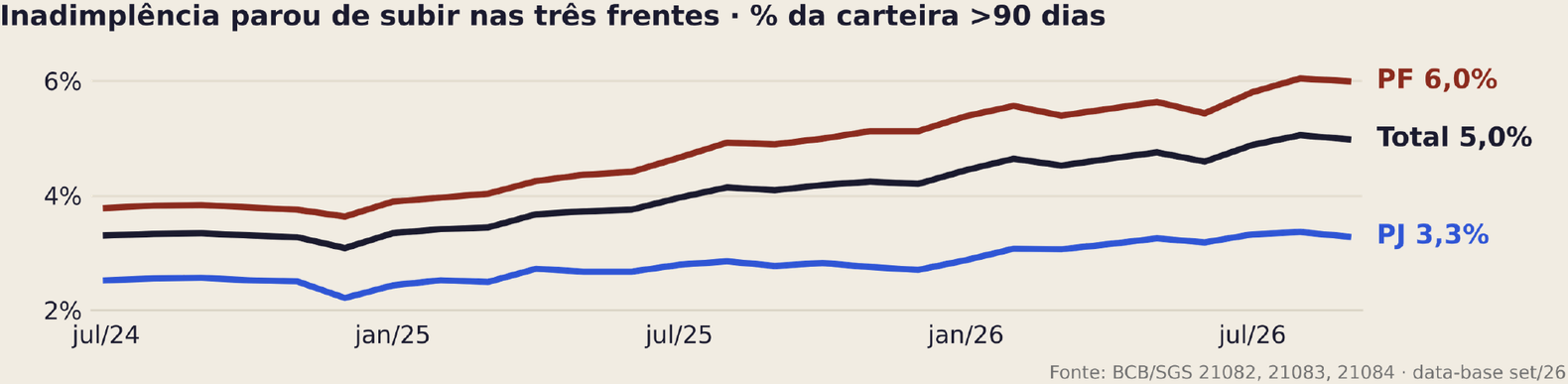
In the second issue of the credit chapter, the financial system's default rate, which measures loans more than 90 days overdue, held at 5.0% in September, the highest in a series that began in 2011, after four consecutive increases. Household defaults stayed at 6.0%, still 1.1 points above a year earlier, and corporate defaults stood at 3.3%.
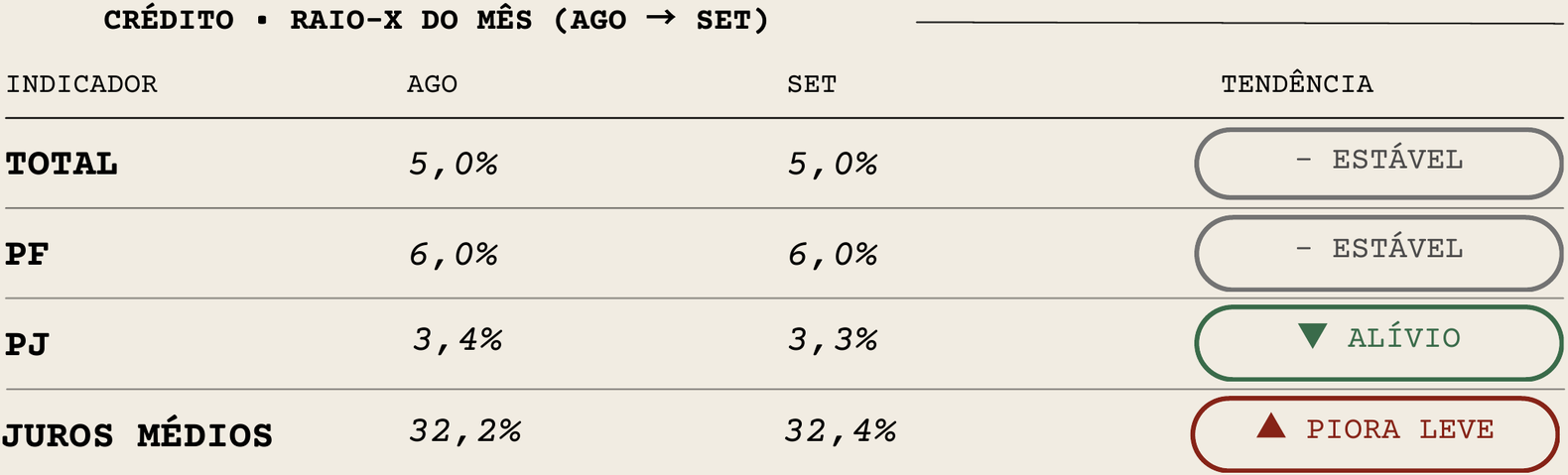
Between August and September, total and household defaults were stable, corporate defaults eased slightly and average lending rates rose to 32.4% a year.
The IBCC, an index that compares credit conditions with their historical average, shows a wider contrast. For households, the index fell to 91.0 in August, the lowest in the series, while for companies it reached 100.4, above the average. For fixed income, this favors lending to companies with good credit quality, the profile of the Ônix Portfolio, and calls for selectivity in assets linked to household consumption and retail, the profile of the Jaspe Portfolio. The return above the CDI, Brazil's interbank benchmark rate, on these securities is the payment for a risk that has not yet eased.
7. Credit market in Ceará
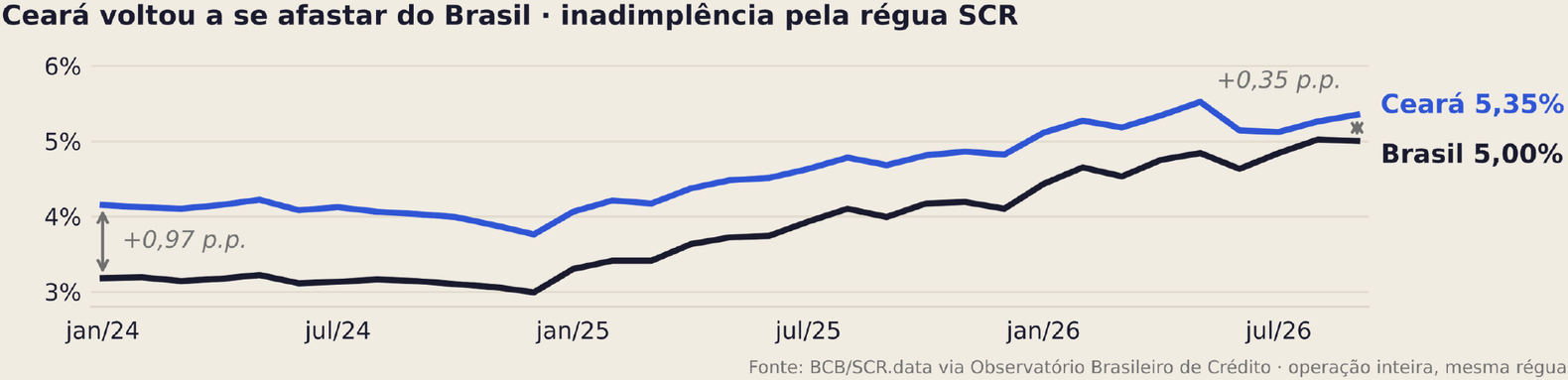
In Ceará, the credit balance reached R$ 180 billion, 2.3% of the national total, and grew 13.7% over 12 months, the second highest increase among the states. According to the SCR, the Central Bank system that records credit operations, the state's default rate rose to 5.35% in September, against 5.00% in Brazil. The gap, which had narrowed from 0.97 point in January 2024 to 0.27 point in July, widened again to 0.35 point. Over 12 months, the default rate rose 0.67 point in Ceará and 1.01 point in Brazil.
Risk remains concentrated in a few credit lines. Among companies, retail has the highest default rate, at 8.58%, followed by working capital, at 6.71%. Among households, personal loans reach 14.19% and borrowers earning up to one minimum wage reach 8.72%. The lines with the largest balances in the state, real estate (1.68%) and payroll loans (3.08%), have low default rates. Among the 27 states, Ceará has the 9th lowest rate, in a range that goes from 3.54% in the Federal District to 9.06% in Maranhão, and now has the lowest default rate in the Northeast, ahead of Piauí (5.38%). For investors, the extra return over the CDI in retail and personal loans pays for high defaults, while payroll and real estate loans do not carry that risk.
8. Tesouro Direto, a bond by bond reading
Tesouro Direto is Brazil's retail Treasury bond program. With the sharp rise in rates after the second round, longer bonds lost value. The table shows yields at the close of November 13. The Tesouro Prefixado 2029 rose 2.32 points, to 14.72% a year, and the Tesouro IPCA+ 2032 rose 1.02 points, to IPCA + 7.70% a year. The Tesouro Selic 2031 pays the Selic plus 0.1076% a year, and the Tesouro Reserva tracks 100% of the Selic with immediate redemption, both with stable prices.
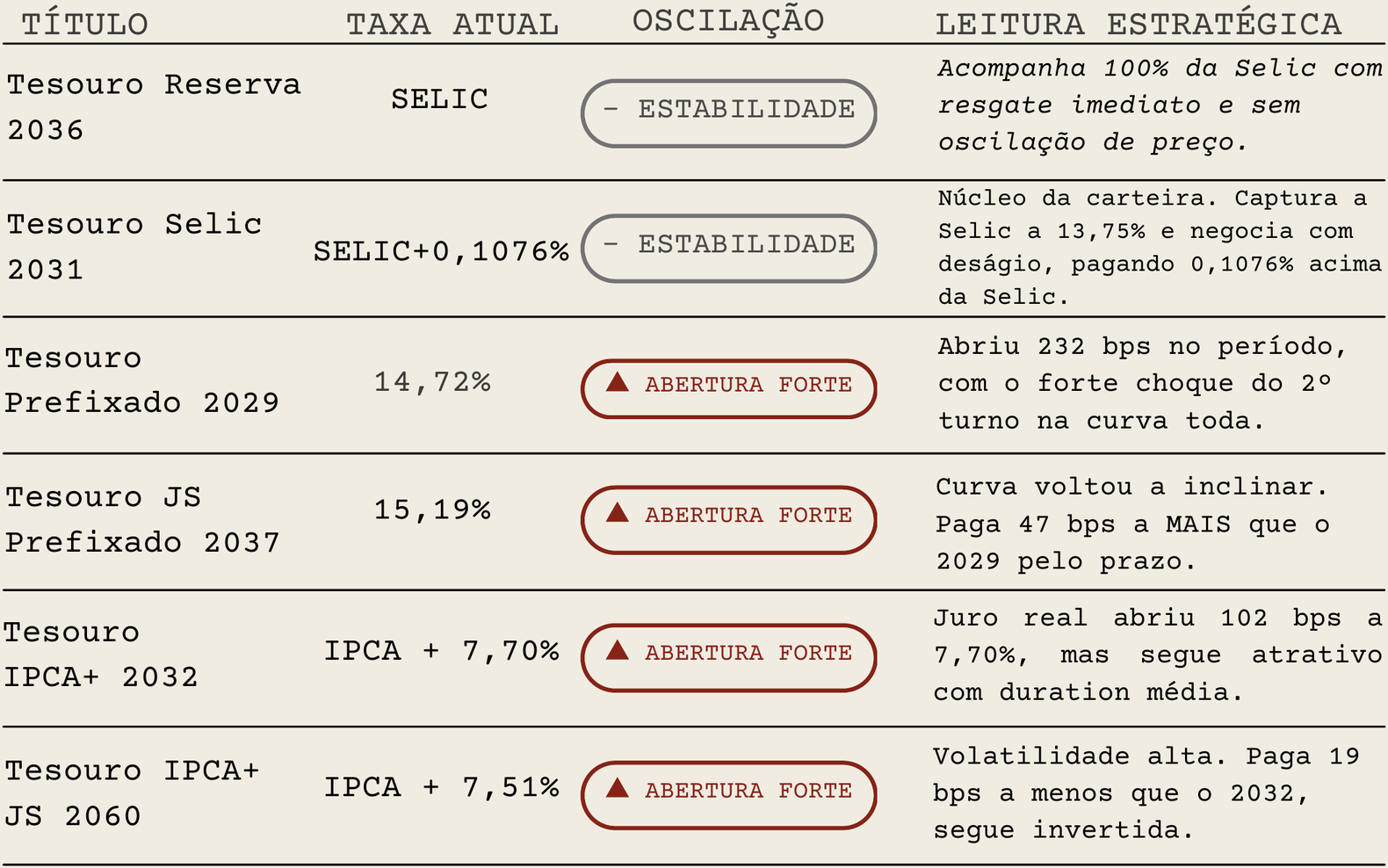
The Tesouro Prefixado with semiannual interest 2037 now pays 0.47 point more than the 2029 bond, against 0.10 point in October, but this gap opened because yields rose, not because of relief. The Tesouro IPCA+ with semiannual interest 2060 pays 0.19 point less than the IPCA+ 2032, a wider gap than in October, a sign that long-term risk is still poorly priced. For this reason, the strategy remains defensive, focused on the Tesouro Selic and the Tesouro Reserva, earning about 13.75% a year with full liquidity until the IRF shows improvement.
9. Interest rate futures, what the DI1F30 showed
The DI Futuro 2030 (DI1F30) is a contract traded on the stock exchange that shows the average interest rate the market expects until January 2030. When the chart rises, the market demands higher rates and fixed-rate and IPCA+ bonds lose value. When it falls, these bonds gain value. Over six months, the contract started at around 14.1% in May, reached 14.99% on June 19 and eased gradually until the Selic cut on September 16. The first round took the rate to a low of 12.21% on October 9, and the second round did the opposite, taking the contract from 12.65% on October 23 to 15.93% on October 26. On November 13, it was trading at 14.89%, about 2.7 points above its lowest point.
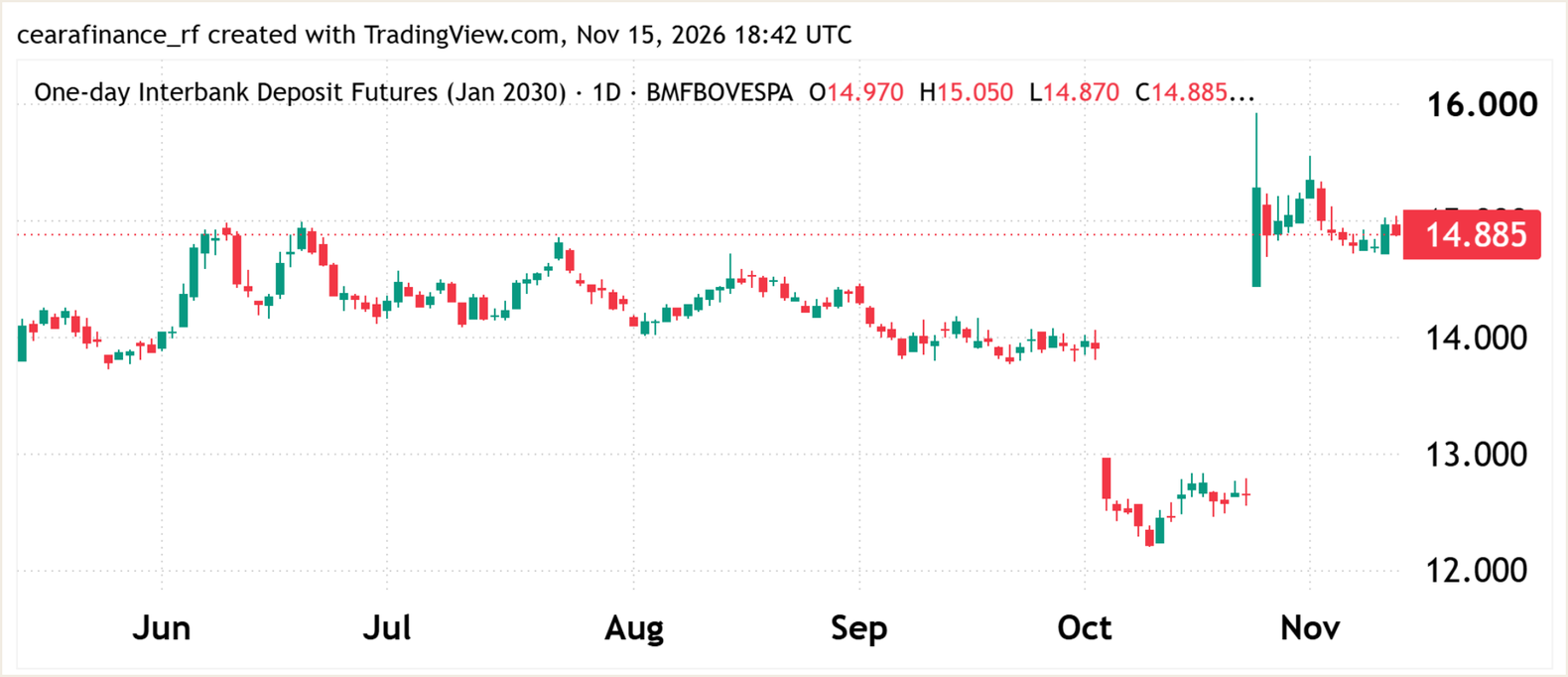
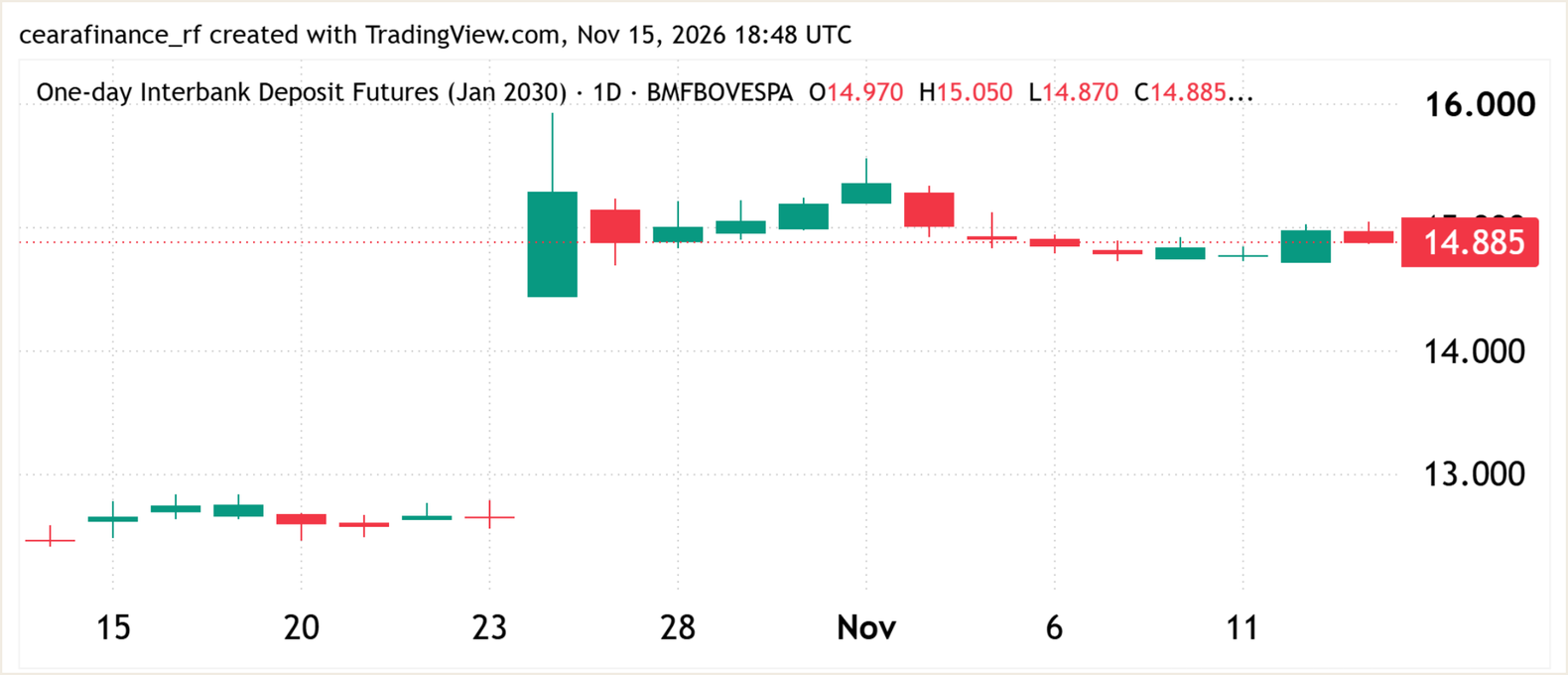
In the one month window, the break is clear. Between October 15 and October 23, the rate moved between 12.46% and 12.80%. In the October 26 session, the first after the second round, it opened at 14.4% and reached 15.93% in the morning. Since then, the contract has given back part of the rise and fell to 14.72% on November 12.
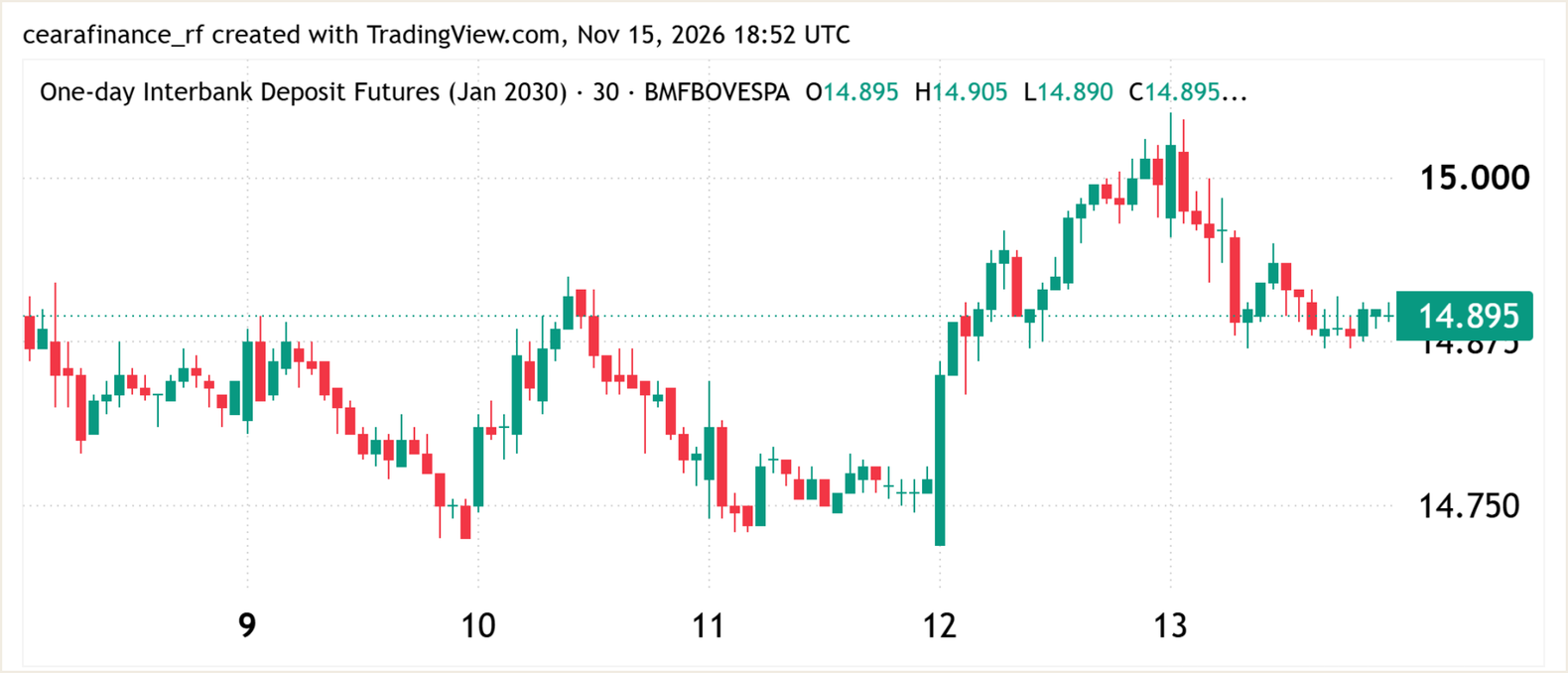
Over the last seven days, the contract traced a V. It hit a low of 14.72% at the opening on November 12, while the market digested the Copom minutes, rose to 15.05% on the morning of November 13 and closed the week at 14.89%, with the fiscal adjustment approved in the Senate and the vote in the Chamber of Deputies ahead.
10. Fixed Income Thermometer, why floating-rate bonds keep winning
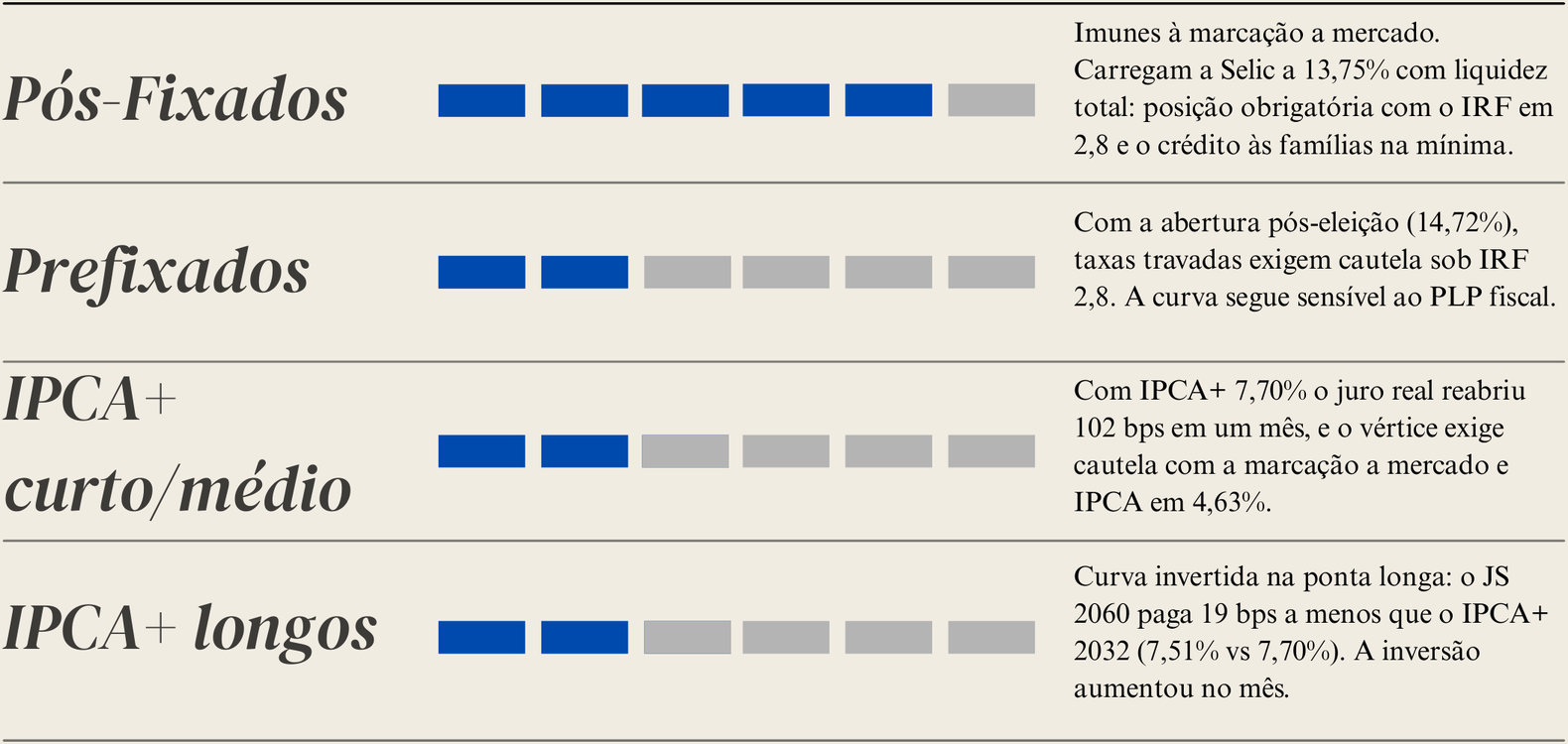
The thermometer compares the appeal of the main fixed income classes at the moment. Floating-rate bonds, which track the Selic, remain in the lead. They yield 13.75% a year with full liquidity and are protected from daily price swings, a rare combination that matters even more with household credit conditions at the lowest in the series. Fixed-rate and IPCA+ bonds gave back all the gains from the first round after the second round result, and with inflation at 4.63% the higher yields still do not compensate for the risk of extending maturities. For this reason, the appeal of IPCA+ bonds fell in this issue.
11. Conclusion
October and the first half of November undid, in a single trading session, the relief that rates had gained after the first round. Monthly inflation slowed, but the 12-month figure remains above the ceiling, and expectations for 2027 worsened. The IRF fell to 2.8 and the Copom paused its cuts, confirming high rates for longer. In credit, defaults stopped rising in Brazil but did not fall, and conditions for households are at the lowest in the series. The strategy remains focused on the Tesouro Selic and the Tesouro Reserva, and the move to fixed-rate and long IPCA+ bonds will come when the IRF crosses into the transition zone. The chart below shows the indicator's path since June and how it moved away from that zone again.
Disclaimer
This material is for information and educational purposes only and was produced by the Fixed Income team of Ceará Finance. It does not constitute a recommendation, offer, solicitation or investment advice. The analyses reflect public data available up to November 13, 2026 and are subject to change without notice.
Project team
Kauê Brito, Levy Freitas and Raquecia Torres.